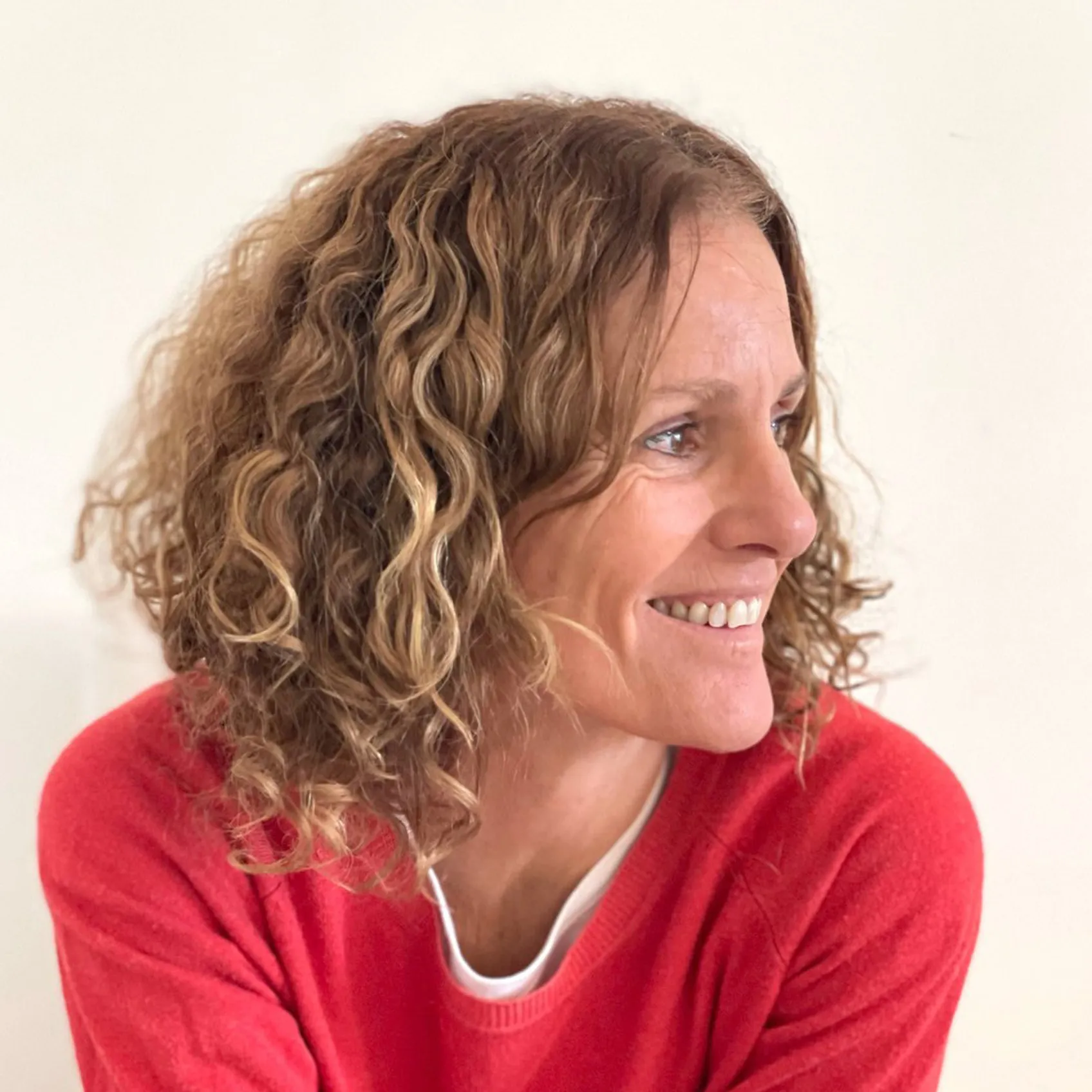
Clara de Estrada was born in the city of Buenos Aires in 1970. Her childhood unfolded between urban life and summers spent in the countryside, a setting in which she developed a vital bond with animals.
In 1984 she traveled to Rome, Italy, where she completed her secondary education. Her exposure to Italian literature and her fascination with Dante led her to define her university studies upon returning to Argentina in 1989. She continued her literary education at USAL, and in 1996 earned a degree in Literature as well as a certification in Text Editing and Proofreading. From that point on, she worked as a proofreader for major Latin American publishing groups such as El Elefante Blanco and Editorial Norma. She traveled throughout Latin America and lived in Bogotá, Colombia, from where she carried out her work. In 2002, back in Argentina, she decided to shift the course of her professional career when her artistic path revealed itself to her: photography.
Her encounter with photography sprang from curiosity. By distancing herself from her literary profession, Clara de Estrada found in images a language that she made her own through her singular perspective. An enthusiast of pictorial art, she participated for the first time in a photography workshop under the guidance of Inés Miguens, driven by a sensibility that was more emotional than formal. From this first experience she gained technical training and a love for photographic development, at a time characterized by analog, roll-film photography. She also gathered her first female photographic references there, such as Julia M. Cameron, Sally Mann, Sarah Moon, and Tina Modotti. Fundamentally, however, this space marked the starting point of a broad journey of independent training that would lead her to consolidate a distinctive personal style, nourished by the guidance of outstanding contemporary masters.
From her training with Lutz Matzchke stand out the work on deconstructing the gaze and the possibility of seeing beyond any image. From Juan Travnik, she took on the specificity of technique and professional practice. With Lorena Guillén Vaschetti, she explored the emotional dimension of images and began working on what would become her first photobook. She completed its editing with Abraham Votroba, one of her most important mentors, who brought meticulousness and a narrative drive to all her work. She also trained with Julieta Escardó, with whom she investigated the editorial work of her own production—something that has characterized Clara de Estrada since her first profession. With her, she deepened her knowledge of the history of photography and the imprint of written texts within photographic creation. Julieta Escardó is currently her editor and, as head of La Luminosa editorial, published her two photobooks.
Her artistic production is strongly linked to her commitment to the environment and to animals. The harsh experience of rural life that marked her first encounters with them pushed her to rethink the bond between species through the possibility of conscious coexistence. Thus, in several of her works she explores the connection between humans and animals from a sensitive, poetic, and critical perspective.
Clara de Estrada’s gaze expresses a dialogue between photographs and what lies beyond them: what is named, evoked, and contained within them. It operates through implicit signifiers that inhabit certain fragments of the world. Through anthropological, pictorial, and literary concerns, a hybrid language emerges that reveals within it a way of thinking, of speaking, and an authentic form of expression through images.
She currently lives in Buenos Aires. She is a founding member of Fundación Zorba (animal welfare) and collaborates with Fundación Potencialidades (children’s play libraries in marginalized areas).
Since her beginnings, she has participated in group exhibitions curated by Inés Miguens (2003–2005) and Lutz Matschke (2006). More recently, her work was selected to be presented in Nice, France, as part of La vie en BleuInternational Residency, a competition organized and curated by Ximena Echagüe (2024). She has held solo exhibitions atHouse of Art, curated by Romina Méndez Castelli (2021); atEl Más Acá Club Cultural in Buenos Aires (2018); and at MUBATA (Museo de Bellas Artes de Tres Arroyos) (2025). In 2026, she participated in the group exhibition Registro Abierto at Galería Julia Baitalá in Buenos Aires, Argentina; and in the exhibitionHorizontes de lo visible at Galería Nueva in Madrid.
She works as a freelance photographer for various magazines (Sofía, Caras, Barzón, Oh My Dog) and for different brands.
She published the book Correr para vivir (Running to Live)(2016) for Fundación Zorba and participated in the guide Buenos Aires Guau (2015), published by Editorial Larrivière, together with Isabel de Estrada and Melina Zukernic.
She is the author of two photobooks: La única foto (The Only Photograph) (2019) and Avistaje (Sighting) (2025), both published by La Luminosa editorial.